SPECS — ImpuritieS ImPacts and ManagEment for CO₂ Storage
A 42-month Horizon Europe research project unravelling the impacts of CO₂ impurities on the geological storage complex — from the injection well to the caprock — to derisk CCS deployment at industrial scale.
Making CO₂ storage safer for mixed-source streams
To meet the EU’s challenging carbon-emission-reduction objectives, Carbon Capture and Storage (CCS) is set to scale to industrial levels in the coming years. As capture capacity grows, storage operators will increasingly inject CO₂ streams combined from different sources — each carrying its own mix of impurities. These impurities can pose specific challenges for the safe design and operation of CO₂ transport and storage networks, and Directive 2009/31/EC requires that they remain below levels that risk transport and storage integrity, the environment, or human health.
While the effect of impurities on CO₂ transport (corrosion, flow assurance) has been widely studied, their impact on the integrity of the storage complex itself — wells, reservoir rock, and caprock — has received far less attention. SPECS is built to close that gap.
The SPECS project unravels the impacts of impurities system-wide, from the injection well to the caprock, and delivers protective, mitigation, and monitoring solutions, together with guidance for technology providers, regulators, and standardisation bodies. The overall ambition is to facilitate access to storage for more CO₂ stream mixes and improve the economics of the CCS chain.
An integrative approach to the storage complex
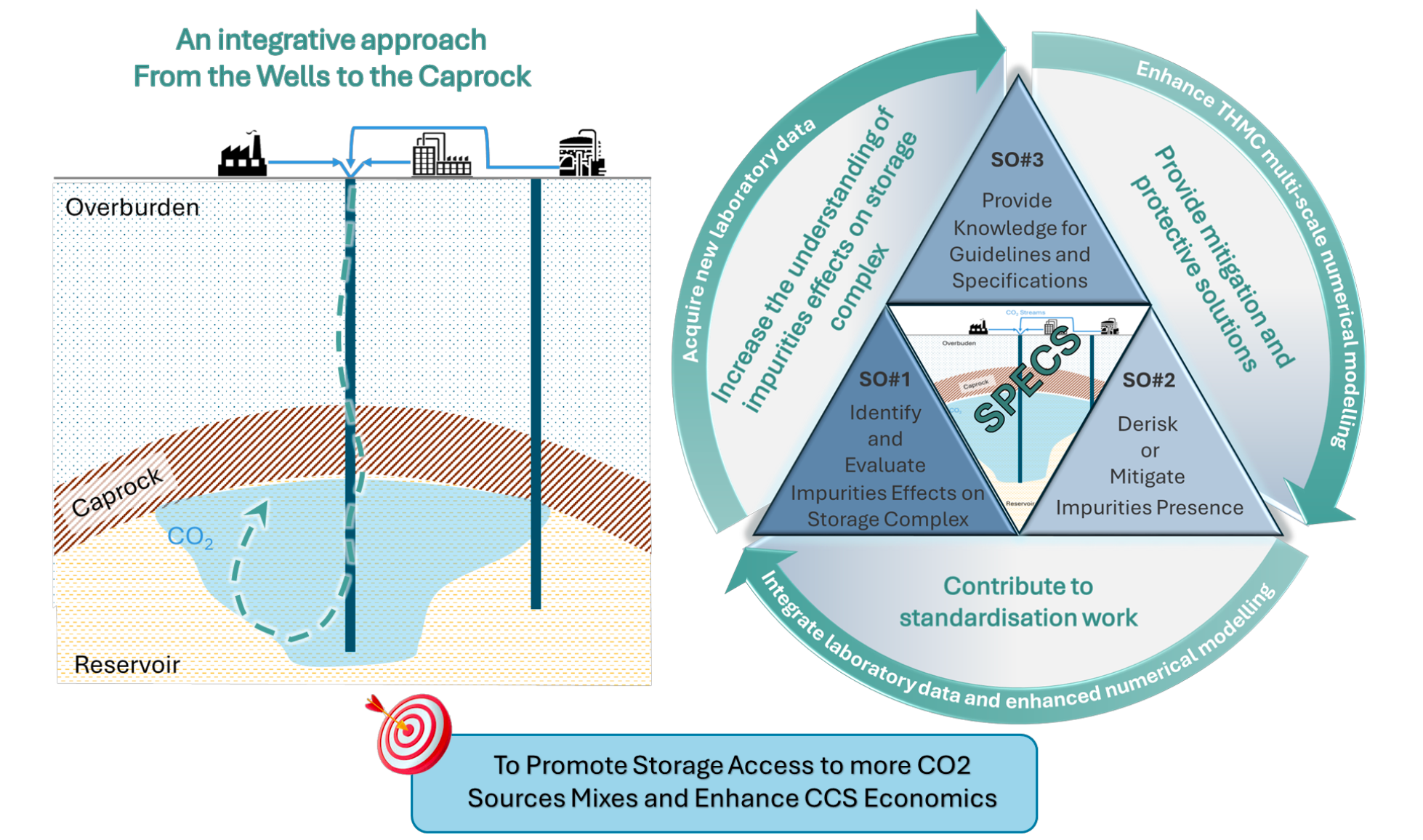
SPECS takes an integrative view of the entire CO₂ storage complex — from the injection well, through the near-wellbore region and reservoir, all the way to the caprock — assessing how impurities affect each component and the system as a whole.
Why · How · What
SPECS combines laboratory experimentation, numerical modelling, and direct engagement with industry, regulators, and standardisation bodies to fill a critical knowledge gap in CCS deployment.
The challenge
As CCS scales, multiple CO₂ sources will share the same transport and storage infrastructure, meaning operators will inject mixed CO₂ streams with varying impurity profiles. Today, the effects of these impurities on the storage complex itself remain insufficiently understood — a gap SPECS is built to close.
The approach
SPECS is built on an integrative approach to the storage complex, combining experimental work, advanced modelling, and stakeholder engagement. The project covers well integrity, near-wellbore injectivity, in-depth storage behaviour, caprock integrity, and recommendations for guidelines and standardisation.
The outcomes
Three strategic objectives drive the project:
- Identify and evaluate physico-chemical impacts of impurities on the CO₂ storage complex.
- Derisk or mitigate adverse effects caused by the presence of impurities.
- Provide knowledge for guidelines and specifications for CO₂ compositions for storage.
11 partners across Europe
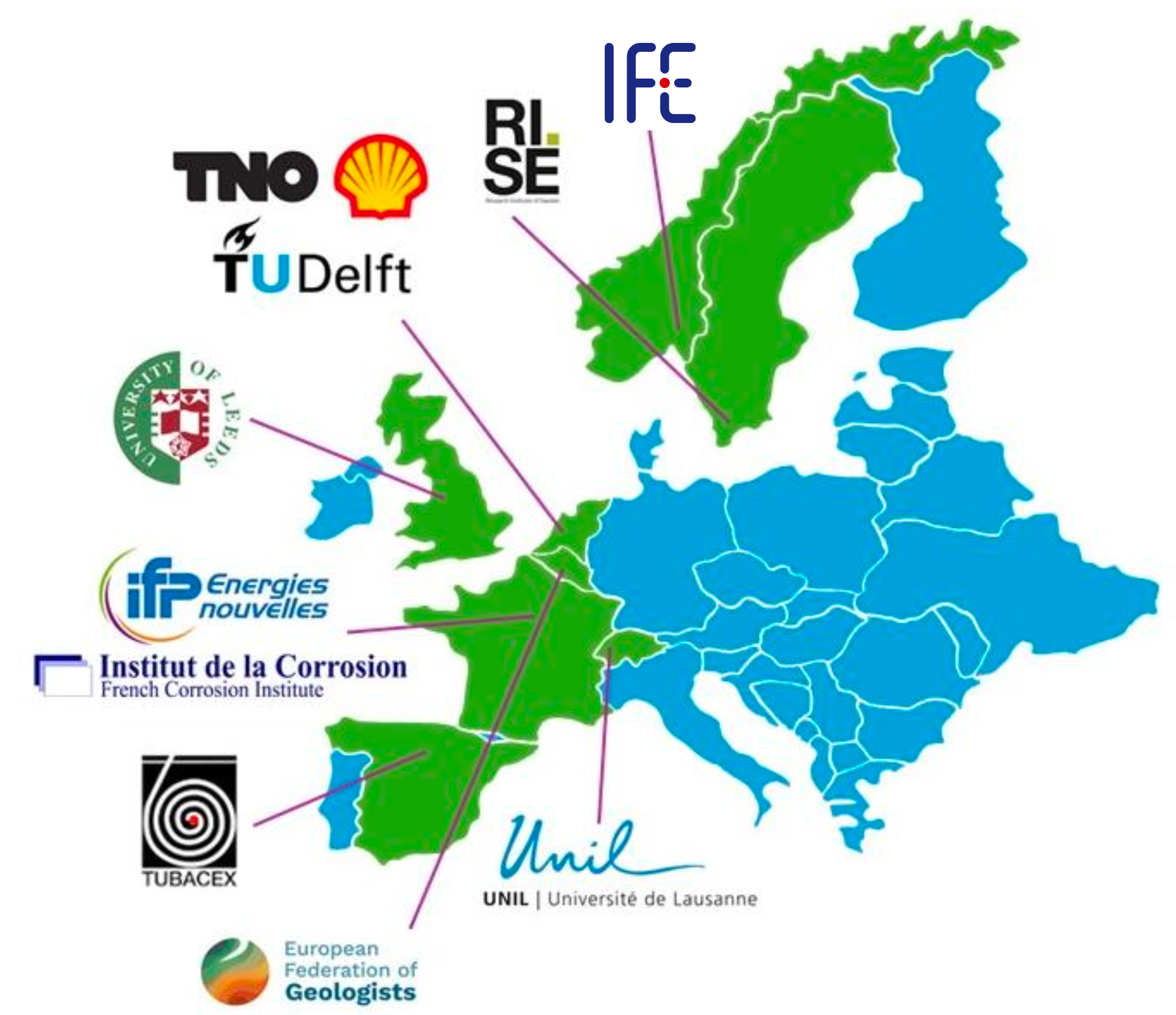
SPECS brings together six research and technology organisations, three universities, one European association, and one industrial associated partner — covering the full knowledge chain from materials and corrosion science to reservoir geomechanics, geochemistry, and standardisation. Coordinated by IFPEN (France).










Get in touch
IFP Energies nouvelles (IFPEN)
Valentin Guillon – Project Coordinator
IFP Energies nouvelles, France
coordinator@specsproject.eu
European Federation of Geologists
Pavlos Tyrologou, Maria A. Lopez, Anita Stein
Rue Jenner 13, B-1000 Brussels, Belgium
comms@specsproject.eu